

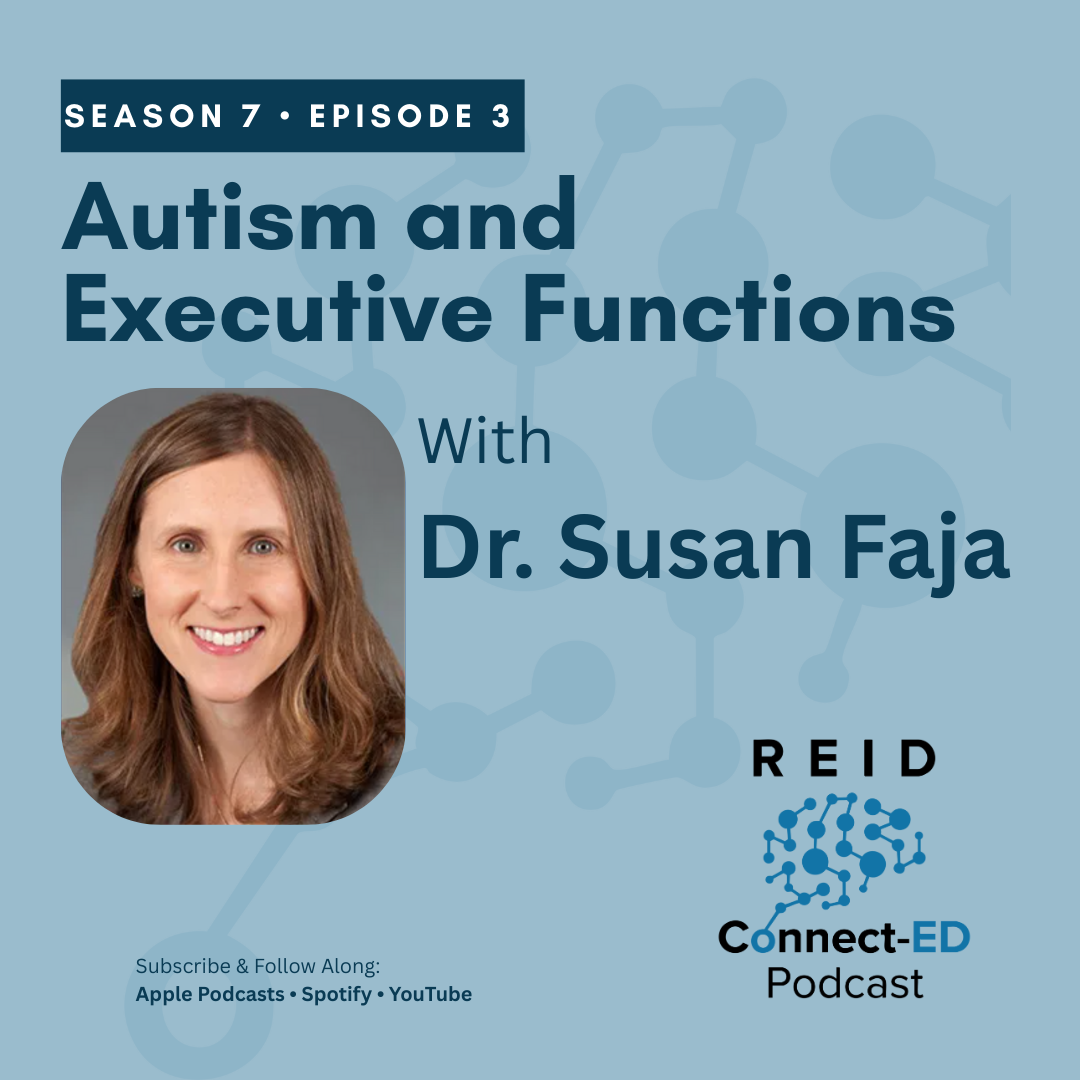
S7 E3: Autism and Executive Functions w/Dr. Susan Faja
Listen Now!
-
https://research.childrenshospital.org/research-units/faja-laboratory-research
Dr. Susan Faja, who is a psychologist at Boston Children’s Hospital specializing in the research of individuals with Autism, particularly children. The Faja Lab led by Dr. Faja seeks to understand changes in brain systems of executive control, social cognition and social perception resulting from targeted interventions that use electrophysiological as well as behavioral measurement tools. She leads the Faja Lab, where her approach allows for the exploration of the developmental processes that contribute to behavioral symptoms, clarifies how interventions work, and provides a platform for rigorously testing novel interventions. Additionally, Dr. Faja seeks to understand why and how individuals with Autism can present so differently in their development, as a way to better understand causes and inform individualized treatments.
-
Executive functions include skills like planning, cognitive shifting between tasks, and organization, which are skills that allow us to complete tasks and navigate daily life efficiently and effectively. It helps us to use meta-cognition, to think about our own thinking and what we focus on in order to be strategic in how we adjust and adapt.
Individuals with Autism generally struggle with a number of executive functions. However, some individuals with Autism actually do not show executive function challenges.
Planning is a particular executive function skill that most Autistic individuals struggle with. This can manifest as having a hard time getting stuck during a task and not shifting what they are focused on. It can look like going with the first idea that pops in their mind rather than considering multiple options to achieve a goal, as well as not using a future idea to inform the present.
At the same time, it can be a huge strength for someone with Autism to maintain precise focus in one direction and to be so tuned into the present moment in order to go deep into a topic or problem.
In 2013, with the new DSM-IV criteria of Autism, the field began to look at the overlap between Autism and ADHD. This is still being fleshed out in the research, and overall if someone also has an overlap of ADHD co-occurring the executive function challenges will likely be more significant.
Some individuals with ASD are more or less sensitive to sensory stimuli. Executive function may be less able to filter out over stimulation. At the same time, it may be that their sensory processing/perception system may overwhelm the person’s executive function to control and filter out. Additionally, some with ASD do not show any sensory sensitivity differences, while others have a mix of both under- and over-stimulation.
Sometimes in particular contexts, individuals with ASD may show much better ability to use executive function skills. Working memory may play a role in these differences, such that certain contexts may tax the person’s working memory - ability to hold and manipulate multiple bits of information at one time - could get too taxed.
Some research suggests working memory operates with visual and verbal information. Some may show strengths and/or weaknesses with verbal versus visual information.
Individuals with ASD may be very good problem-solvers and use executive functioning when they are motivated with a tangible reward, with an immediate goal being met. The reward system can kick in.
Dr. Faja’s research so far is suggesting that executive function skills on ‘cool tasks’ are related to how individuals perform on ‘hot tasks’ when they are motivated by a reward.
It can help to ask the person with ASD if they prefer person-first (“Person with Autism”) or identity-first language (“Autistic person”).
Dr. Faja’s work has focused on how executive function computer games could help individuals with ASD practice and develop their EF skills. The research found that it was important to have a person with the individual facilitating the practice and discussing how to identify ways the skills in the games could be applied in real-world settings. Findings suggest improvements in the ability to be flexible in real-world situations, such as when there is rigidity around wanting things to be the same.
Other research groups with the most clear and convincing findings practiced these skills in a social context in the classroom, finding improvements in flexibility in social settings.
The preference for sameness could interfere with trying new things and so research can continue to investigate if improvements in flexibility could lead to downstream effects across areas of life where rigidity is seen.
Practicing flexibility requires gradually increasing the level of complexity in which this skill is used. This makes the practice individualized where the individual can be provided the scaffolding and support to gradually practice flexibility across different and perhaps more challenging settings. It’s sort of like finding the ‘sweet spot’ where the challenge is not too easy or too difficult, but just enough and also across contexts. This can be difficult to scaffold and manage for adults in the child’s life in times when emotions and frustration reach high levels both within the child and subsequently from the adult in reaction to the child’s emotional reaction.
Practicing flexibility for instance on a computer can be like being the ‘batting cage’ practicing their swing and then can take it into the real world setting.
Alexis often encourages parents to make intentional slight shifts with their young child to practice flexibility in a positive and encouraging way, such as during an interactive game (e.g., “Lets look for everything that is green around us. Okay, let’s change it to yellow.”)
Dr. Faja explains how there has been a lot of investment in being able to identify early development signs of Autism, with a lot of progress. Dr. Faja explains how there are signs in the brain and behavior that show early markers for identifying Autism early on and allows for future research to understand how the diagnosis unfolds over time.
Dr. Faja explains that over the past decades we are seeing more positive outcomes among children on the spectrum, benefiting from the services and more able to engage in a meaningful way with their environment. There are a wider range of services and at different ages, including with adults. It is neurodevelopmental so the ASD profile tends to exist across the lifespan.
Dr. Faja explains that individuals with ASD are having more of a voice with researchers to inform their lived experiences, which can help interventions be more inclusive. There is still a lot more to learn to individualize the care better. There are different kinds of Autism with different factors that contribute to these different profiles, so there is a lot more to learn and understand how to support those with different profiles.
It can be a misunderstood belief that individuals with Autism do not want relationships and that they are just in their ‘own world’. In fact, although there may be differences and a range of motivations, many individuals with ASD actually have a desire for relationships, even romantic relationships, and wanting to ‘do right’ by those with whom they have a relationship. Dr. Faja has worked on research to better understand how to support individuals with ASD in their romantic relationships.
Over the past decade there has been a shift between labeling someone as having Asperger’s Syndrome (DSM-IV) to now being simply classified as having Autism Spectrum Disorder (DSM-5). Initially, the Asperger’s diagnosis was related to the difference of others on the spectrum in terms of not having cognitive, developmental, or language delays (past or current) in terms of verbal reasoning or ability to generate language, even if there were subtle differences in how words are used in conversation. This Asperger’s classification does not exist anymore because there is a lot of overlap among individuals who meet criteria for Autistic Spectrum Disorder. Clinicians were not consistent in how they classified Asperger's Disorder versus a classic Autism diagnosis. Also, the two groups did not show a lot of reliable differences in intervention needs or different factors that would contribute to leading to Asperger’s Syndrome presentation versus Autism.
Cognitive ability is one of the reasons people may be committed to maintaining the Asperger’s Syndrome label versus Autism. However, it is also possible to qualify for an Autism diagnosis even without cognitive impairment. There is a range of cognitive ability across the range of those on the Autism spectrum. We think of different categories where some have Autism alone versus having Autism plus intellectual disability/impairment.
Practicing executive function skills can feel intrinsically rewarding to feel confident, competent, and capable, and may not always require an external reward.
-
Gerald Reid 00:00
Welcome back to season seven of the Reid Connect-ED podcast, co hosted by myself Licensed Psychologist Dr. Gerald Reid and my sister educational therapist Alexis Reid providing resources on mental health, education, and performance psychology. We are so fortunate to be joined by Dr Susan faja, who is a psychologist at Boston Children's Hospital specializing in the research of individuals with autism. The Faja lab, led by Dr Faja, seeks to understand changes in brain systems of executive control, social cognition and social perception, resulting from targeted interventions that use electrophysiological as well as behavioral measurement tools. She leads the Faja Lab, where her approach allows for the exploration of the developmental processes that contribute to behavioral symptoms. Clarifies how interventions work and provides a platform for rigorously testing novel interventions. Additionally, Dr. Faja seeks to understand why and how individuals with autism can present so differently in their development as a way to better understand causes and inform individualized treatments.
Alexis Reid 01:16
So let's briefly review Dr Faja’s credentials. Dr Susan Faja studied neuroscience at the University of Michigan before receiving her doctoral degree in child clinical psychology from the University of Washington in 2009 she completed an internship at UCLA in the developmental disabilities track and postdoctoral fellowships focused on clinical neuroscience at The Children's Hospital of Philadelphia and the University of Washington. We're so eager to have this chance to speak with you in a long form about autism. There's always been such a keen interest in autism on so many levels, from causes to presentations to how we can support individuals. We're so grateful to speak with you today and for you to provide our audience with some helpful information that they can turn to. So my interest, of course, is in executive function and learning, since those are the skills that I support in the learners I work with, but I'm so curious to hear more about the work that you do. Thank
Gerald Reid 02:12
you so much for joining us.
Susan Faja 02:13
Susan, thank you. It's so great to be here. I'm really excited about this conversation.
Gerald Reid 02:18
Yeah, I think one way to start this episode, just to orient the audience, I know we talked about executive function a lot on our podcast with Alexis and myself and other guests. Can you share, you know, how do you view what executive functions are? It's kind of this term that people may be like, you know, executive function. What does that mean? Executive like a boss. What is the executive function mean exactly to you?
Susan Faja 02:39
That's a great question. I like your reference to executive function being kind of like a boss. I do think of executive function a little bit like what you imagine a cartoon brain doing, of just kind of being in charge of everything else. So it's like the boss of your brain. It's a set of thinking skills that we have, and we use those skills to respond to new situations that we haven't encountered before, or when we're in situations that require some sort of strategy or complex response, where we have to kind of put some pieces together
Gerald Reid 03:12
Interesting. Yeah, in a previous episode, Alexis and I talked about this, and I was remembering the Simpsons cartoon, and remember Homer Simpson, when he would make a mistake he wouldn't inhibit himself, which is an executive function skill. He would hit himself on the forehead with his hand. And they're like, Lex, that's where the executive functions lie in the part of your brain
03:34
to do what you need to do.
Gerald Reid 03:35
So Susan, can you share how executive function looks with someone with autism. And, you know, I think the lay person may have a general idea of what someone with autism may look like or present as, but maybe not see the underlying skills that can essentially manifest into behaviors or different ways of relating that could seem different perhaps.
Susan Faja 03:59
Yeah, so I think in autism, some people don't realize that individuals on the autism spectrum can have difficulty with executive function, but what we know from research that has kind of looked across all different studies that have focused on executive function and autism, that there are some patterns that emerge in the most common profile. And so let's start there. So on average, what we see for people on the autism spectrum is that there are difficulties with sort of the highest level aspects of executive functioning. So when we talked about how we use executive function in situations that require planning or strategy. Those planning skills are the things that come up on average across the most studies and with the biggest effect. And what that means is that it's probably because there are different profiles of executive function challenges with some of the other. Other executive function skills that feed into that planning ability. And so for individuals across the spectrum, we might see somewhat different profiles, but if you have other kinds of executive functioning challenges, they're going to impact your ability to plan or problem solve in a strategic or efficient way. So when we see someone struggling with executive function, maybe they're doing things more slowly or in a way that's not maybe the simplest or most straightforward or fastest way to get a problem solved. It may be, you know, sort of lead to an interesting or creative or sometimes even better solution, but it could take a long time or maybe less direct. So I'd say that's sort of the average profile. But one of the interesting things is that we can see different profiles for people on the spectrum, and I think that's important to remember as well. So when we look at an individual level, we may see challenges with certain aspects of executive functioning, like working memory, which could impact our ability to kind of integrate information in real time, or things like shifting so our ability to kind of go back and forth between different ideas or different strategies. Those are some of the other kind of more common ones across studies that are affected in terms of the skills or the profiles, but we also see that some individuals on the spectrum have absolutely no difficulty with executive function, and so that's kind of an interesting piece of the puzzle, and an important one to keep in mind.
Gerald Reid 06:33
Oh, interesting. Okay, I want to pick apart one thing you said about planning, kind of being one that is kind of global, that a lot of people with autism tend to struggle with planning, and you said, it's almost like they're not necessarily looking ahead and then working steps backwards. So what could that look like, if someone's working on a task? Is it kind of like they're just focused on the present moment so much without thinking ahead and then using what they're thinking ahead to to inform what they're doing now? Exactly?
Susan Faja 06:59
Yeah, so it could be kind of getting stuck on one part of the problem and not kind of thinking about how to move, you know, what's the big picture, what's that long term goal? It could be just, you know, being very detail oriented. It could be kind of taking whatever strategy pops into our head first, rather than kind of evaluating which strategy would be most effective. Interesting.
Alexis Reid 07:27
I think it's so interesting because, you know, planning from an executive function perspective too, I always break it down into thinking about we can plan how to accomplish a task, but there's so many life skills related to planning too, like, how do you think ahead for what or anticipate what you might need when you need to make a change or a shift? And I think one of the difficulties in even discussing executive function for folks to understand it, is that pretty much everything in our lives kind of comes back to executive function skills. So for individuals with autism in particular, I wonder if we can kind of go down this planning path a little bit more, because I think it's so important for folks to recognize and especially caregivers and educators who work with with folks on the spectrum who often have some really great strengths and abilities that they might forget that this is a skill that's so important to be developed, scaffolded and supported.
Susan Faja 08:23
I'm still thinking about your comment about thinking way down the road. So one of the things that I hear from autistic people, and just thinking about what this might look like in real life, is that there's a tendency to be very in the moment, and so thinking about what's right in front of me, and the part of the problem that I'm solving right now, or the the materials or information I need for right now, and not necessarily being able to jump back and forth necessarily as easily and into the future. Kind of put those pieces together in that longer view. And so I do wonder how that may interact in terms of that right now, which can often be very helpful to be very mindful and present. But I think executive function allows us to step outside of that presence and then do what we call metacognition, so thinking about our thinking and thinking about what's going to be required, either coming at the problem from different angles, or thinking about what the next steps might be in that problem.
Gerald Reid 09:29
Yeah. So so this, you can see this manifesting, perhaps with a child who is having a hard time moving away from something because what they're doing is not working, and that seems to be like, a pretty prominent feature of someone with autism as they they kind of call it getting stuck or inflexible and and so the difficulty with planning and Alexis, I like what you said, too, is that planning also involves what your needs are and what your needs are in the moment. May not be what your needs are in the future, and you may not get your needs met if you're not seeing. Seeing that in the future you may need something different from what you need right now, which is definitely can happen.
Susan Faja 10:06
Yeah, I think another thing that I hear a lot about and see in some of the autistic people that I interact with or their families, is organization. And I think that, again, that planning kind of comes along with being organized or appearing organized to others. So just kind of thinking about, what am I going to need an hour from now or tomorrow? What do I how do I kind of want to set up my environment to, you know, to not only be like, right, what I need in this moment, but, you know, in other situations, or if someone else had to, kind of like, understand my organization, what would that look like? Yeah, and being
Gerald Reid 10:46
disorganized definitely makes it hard to plan ahead. If your mind is just disorganized and having a hard time figuring out what to do next, you know, definitely makes you overwhelmed and anxious for sure,
Susan Faja 10:57
one of the pieces of executive function that my lab is most excited about is pretty related to organization, and so we're really interested in how executive function contributes to being able to filter out information. And I think that kind of filtering or directing your attention to different things is a piece that is also very important and seems pretty intertwined with some of the features that we see in the autism
Gerald Reid 11:24
profile. Yeah, can I ask you a question? You made a good comment previously that sometimes this way of thinking, you know, we kind of think of strengths and weaknesses or vulnerabilities, however we want to describe it depends on the context. Right, one person's weakness could be a strength in a different context. You made a comment that thinking this way, being really detail oriented, or just acting on any thought that pops in your head could sometimes lead to a creative idea. Is that maybe, like the flip side or the mirror trait of this challenge that could happen sometimes,
Susan Faja 11:53
yeah, and I think being able to stay focused on something for a really long time can also be a huge strength, and that's something that I think a lot of people on the spectrum can really use to their advantage. And with the autistic people that I've worked with, it's really impressive, like, how focused someone can be. And sometimes that level of focus is required to really get in deep and understand a problem and really solve it, or maybe, like, go at a level that you know, might be less likely to to kind of be understood. So I think that's, you know, that's a it's sort of the two sides of it, right. Like, you know, there's some advantage to being able to stay really focused and really in the moment, and then conversely, like to be able to say, Okay, that's enough. It's time to kind of shift. And do, you know, come at this from a different way, or, you know, to think about it in a different way?
Alexis Reid 12:49
Yeah, there's so many overlapping features between the way we're describing and talking about autism and ADD and ADHD, right? Some folks might have difficulty filtering that that was such a cue for me, filtering the information that's coming in, to organize how we use it, what do we and don't we use? Especially in this media rich world that we're in, there's so much information, it's hard for all of us, I think, to filter information and prioritize what we need to use and do something with it. So I wonder if we could talk a little bit about that too, the differentiation between, say, you know, executive function challenges coming more from Attention Deficit Disorder versus autism. Yeah.
Susan Faja 13:32
So this is a really active area of research, and we're really trying to figure out what that overlap is, because with the new diagnostic criteria that came out in 2013 it was the very first time that the field was really allowed to think about that overlap between autism and ADHD. And so we know that executive function challenges are not unique to autism. There are certainly executive function challenges in the profile of many kids with ADHD, or many people with ADHD or ADD and so what that looks like, and what that profile looks like is something that we're still trying to sort out, I think, as a field, you know, we and others have tried to pick that apart. And you know, my my lab did sort of a deep dive into the inhibitory control, including some of that inhibition of information that was coming in. But I think we don't, you know, we don't fully understand what that overlap looks like. I will say that there is a high level of co-occurring diagnosis of autism and ADHD. And I think in general, what, what the research would suggest is that for children who have both of those diagnoses, or adults that you would expect to see more executive function challenges, whether or not there are unique profiles. I think you know, the research is still a little bit. Are unclear, although people are definitely trying to, again, look across studies and figure out what those patterns are. But in general, the level of executive function challenge will go up if you have both of those diagnoses. Interesting.
Gerald Reid 15:14
It reminds me of how some researchers, I think, are trying to look at the overlap between ADHD and dyslexia, that there could be similar brain pathways and what that means, yeah, okay,
Alexis Reid 15:26
I just want to touch that on that again, because I I think a distinction, and please tell me if I'm wrong, an important distinction is this, like over sensitivity sometimes to the environment through our senses. Can you maybe talk a little bit about like, and I want to bring like, the individual with autism, into the room right to hear more of their first sectors, because you do so much work in really fully understanding their experience, and thinking about how maybe just like different environmental features can really impact an individual on the spectrum?
Susan Faja 16:04
Yeah, that's such a great question, and one that we don't really again, we don't understand fully yet. At the same time that the diagnostic criteria changed to allow that co-occurring diagnosis to be made, one of the other important changes to the autism criteria were that we started to recognize those sensory features of autism, and so we know from our diagnostic criteria that some people on the spectrum will experience more sensitivity to sensory input. They'll sort of be hyper sensitive and maybe more distracted or more bothered by that kind of sensory input from their environment, which comes back to that filtering. You know, there may be some executive function at play, either in terms of not being as able to filter out or kind of shift away from those kinds of environmental cues. Or it could be that there's something different about that sensory processing system that's overwhelming the Executive Function System, you know, there's just too much information. And it wouldn't be possible for anyone's Homer Simpson, you know, kind of boss brain to control that. So, you know, it would be too much information for the Executive Function System to be able to filter out, or, you know, to stay focused in that situation. Conversely, there are some people on the spectrum who are less sensitive to sensory information. And again, I guess it brings up the question of whether that's a tuning, you know, what's, what's the interaction there with, like the executive function, kind of top down control system that we have. And then, of course, there are people who have no, no sensory features, because it's not required we see those sensory features in our diagnostic criteria. And so some, you know, some people on the spectrum don't experience any kind of sensory differences. And some some people experience a mix of sensory experiences, too much or too little. So still, lots of things to figure out on an individual level,
Alexis Reid 18:09
definitely, and I'm asking a lot of these questions, also from, like an educators perspective, because I'm constantly working in professional development development settings, helping folks to think about how we can even use our environment to help support executive function activation, especially for those who have greater challenges or vulnerabilities. So you know, I'm thinking about the sensory piece and your work in filtering and organizing that information, and how that how important that is to even validate an individual that this is what's happening, and this is what might feel more challenging. So I'm glad that we're having this conversation and breaking down some of these characteristics for folks to even appreciate the experiences.
Gerald Reid 18:50
Yeah, and it's not their fault, really, you know. And there could probably, you know, there could be frustration from maybe the reaction they get from other people or or their own reactions to the situations that they feel out of control, or the, you know, like they should be able to be better regulated, and so forth and so, you know, it's interesting, kind of like human experience to be in that position where, like, you know, someone with autism is trying to go through the neurotypical world and try to, you know, do the best they can, Essentially, with the way that their brain is operating. Essentially,
Susan Faja 19:23
yeah. So I think you know, for people who are wanting to support autistic people in their lives, or for autistic people, you know, there are going to be a lot of individual differences here, but really trying to get as much information about what the optimal environment is going to be is really important. So you know, for some people, they may need more sensory input. They might need a busier environment to kind of be optimal. And for other people, you know, it may be the opposite that you know, they they're they're able to use their executive function skills most when it's really quiet and free of other distractions, and they can focus on the one or. Two things that they're really trying to kind of problem solve with.
Alexis Reid 20:03
I always think of like the coffee shop situation, right? Like some people can sit in a coffee shop and read and write and produce, and other people like me, sometimes I'm like, this is just too much. I can't do anything here.
Gerald Reid 20:15
It's so true. I mean, you know, working with some people who have been on the spectrum and, you know, I think this is why maybe sometimes it doesn't get diagnosed. Is that when they're in a certain setting with a one on one setting, I'm thinking to myself, wow, this person has a great ability to take my perspective or another person's perspective in a way that you wouldn't expect if they were on the spectrum. And to your point, are there certain environments where someone could thrive, or at least have a higher potential of using these skills, where they're less overwhelmed or or, you know what those elements are? So I'm really appreciative that you're looking at individual differences, and for people in these kids lives to to understand the individual as much as they're understanding the diagnosis.
Susan Faja 20:57
Yeah, I think about that. You know, the social piece is an interesting one, because executive function is really closely linked to the expression of kind of core autism features, and we know that one of the really core features of autism is differences in the way that autistic people interact socially. And so my team and others have been thinking about how working memory might be related in those kind of face to face social interactions. And so when you're interacting with someone, often you're there's language involved, right? You're like, listening to information, and you're thinking about what they're saying, and you're kind of making sense of that. You may be planning what you're going to say next, or you're thinking about, like what that information means for you and what you'll need to do with that information. So you're already doing two things that you're holding in mind, and then you have to do all these nonverbal things. You have to kind of see what that person is looking at or paying attention to, and you may use nonverbal cues for that, and you may have to hold that in mind and integrate that. There may be emotions that you need to register and kind of integrate, and so you're already, you're starting to load up all of those pieces of information we use working memory when we're trying to integrate or manipulate information. And so being able to be ready to do the next thing in that social interaction really requires working memory, because it requires you to take all of that information that's coming in and kind of move it around in your head and then be ready to generate a response, or plan a planning again, plan a response that makes sense in that context. So that happens when we're adults and we're having face to face conversations, but it also seems like it's going to be really important in language learning. So when you're learning how to use language and what language means, what that person is attending to as those speech sounds are coming in, is that turns out to be very important. What they're focusing on, yourself, what they're looking at, what they're paying attention to, what they're focusing on, is really closely linked with what your understanding of the sounds that you're hearing will be. So we think that working memory can be really related to language development, and we're trying to kind of understand the interaction between language and working memory as we look at executive function, and really young children on the spectrum in my lab.
Alexis Reid 23:23
I'm so glad you said that, and I want to come back. I'm just going to put a pin in this so we don't forget. Because I was so excited to talk about social interactions and executive function, because I talk about this all the time, because we tend to forget how much goes into just being face to face with somebody, let alone missing some cues like a lot of individuals on the spectrum might miss, that others might notice in an interaction, and how that could be misinterpreted. But the language piece is so fascinating to me, and maybe I've missed it, but I'm waiting for the research to come out from the covid days where we were wearing masks all the time, where a lot of young people, especially those on the spectrum weren't getting that additional information from, you know, the way in which we furl our our lips to make a smile or make a sound and and how impactful that is in integrating language into this whole piece of just developing language, but also in socializing. It's so fascinating.
Susan Faja 24:21
Yeah, I think we get a lot of cues. So one of the things my lab is looking at is gesture use as well. And that's really what got me thinking about, as
Alexis Reid 24:29
I'm using my hands. Yes, but
Susan Faja 24:32
it is important, you know, at certain stages in language development to be able to see what people's mouths are doing. So I think that covid data will be really interesting. I haven't noticed, you know, I haven't seen those papers, but, yeah, I have thought a little bit about the impacts of if there's, if there's less information available, yeah, what impact that will have? But coming back to executive function, I think if. Less able to integrate that information, or less able to kind of shift back and forth thinking about other ways that the executive function abilities may impact your social skills. You're constantly kind of shifting between your perspective and hopefully the perspective of the person that you're interacting with. And so that shifting ability and kind of being able to inhibit your own whatever it is you want to talk about or think about, or your own perspective, and kind of shift to that other perspective, I think, is another piece of of how those executive functioning skills may play out. Can you
Alexis Reid 25:36
drill down a little bit more on visual working memory? Because I don't think people even realize that that's a thing.
Susan Faja 25:41
Oh, yeah, thank you. Yeah. So this is interesting. I'm glad you came back to that there's some research that suggests that working memory can be kind of split into different kinds of memory. And so we can remember things that we hear, like I could repeat a list of words for you, and that would be like verbal memory. And then if you asked me to put those words in alphabetical order, that would be an example of how I would use my working memory skills in terms of verbal working memory. I can do the same thing with spatial information or with visual information. So I could take like objects or pictures, and kind of remember what I see. And then I may have to do something like, you know, if you show me a series of pictures, I may have to put them in order, like if they were animals, like the smallest animal to the biggest animal. These would be ways that we would measure working memory. But in real life, you sometimes have to remember what things look like to be able to go back and kind of effectively move through your environment to get back to the things that you need to be able to find. So that's how it kind of play out in real life versus how we would measure it in the lab. You can remember like the cupboard door looked like this, or it had this kind of a handle where I left my keys, or you could remember that I had to turn right and go down the hall to be able to get to it. So that's more like spatial memory. But we can test those things in the lab, and we use them in real life, as we're kind of solving problems day to day. I think we use visual, spatial working memory a lot at the grocery store, you know, what aisle do I need to go to to get this thing on my list? So I have five things on my list, and I'm kind of mapping the grocery store and then kind of putting things in order according to how quickly I can walk through the grocery store and get to the checkout if I'm in a hurry.
Alexis Reid 27:38
And then we add into it, you know, the the marketing campaigns and the flashing lights and the new boxes, and there's so many distractors in the environment that visual, working memory and spatial skills, I think, is so important. And often, a lot of the people I think, Jerry you probably too that I work with struggle a lot with being able to integrate their their visual spatial skills into real life environment. Environments when there are so many distractors that could become so anxiety provoking that they lack the ability to integrate and use their working memory skills in these situations, and I know especially individuals with autism, it becomes even more challenging and difficult where it could turn into, like, more of a behavior and reaction in response to those situations.
Susan Faja 28:25
The other piece that I think about, that I do hear about a lot in terms of executive function, and like, the different experience of executive function for people on the spectrum, is that we use executive function in real life to accomplish goals. So when you were talking about young children, in addition to being good at kind of sorting things, a lot of young kids on the spectrum are actually really good problem solvers when they're motivated. And so we think a little bit about different aspects of executive function. So in my lab, we're interested in something called Hot executive function, which is what we use in situations where there's maybe a more clear, concrete goal, or there's some sort of emotional consequence to the problem that we're solving.
Gerald Reid 29:13
So hot being the emotion. That's where the idea of hot came from. It's more like emotionally driven, like motivated. So
Susan Faja 29:19
hot executive function can be more emotional. That's kind of one way that we could think about hot, but hot also might have some sort of tangible reward. So it's in terms of the goals, it's going to make the goal more immediate and maybe bring up a little bit more internal affect about meeting that goal, the reward system is going to kind of kick in, which
Alexis Reid 29:46
helps collapse that idea we said before about not always being able to plan for the future, because it's more immediate in the response, yeah, potentially right,
Susan Faja 29:55
potentially Right, exactly, but it may help pull. Pull someone towards that goal rather than staying, you know, right in that immediate step of problem solving. So the thing that I think about is, you know, I do an interview where I ask parents how their young child asks for help, and a lot of parents will say, My child just gets whatever they need on their own. You know, whether that's climbing a chair to get the thing that's out of reach or figuring out a way to get the thing open that a lot of kids wouldn't be able to do. So, I think there may be strengths there in terms of problem solving skills that we don't see as often in our boring, lab based tasks where, you know, there's no real reason to solve the problem. So I think we know, we wonder about that for kids on the spectrum too, like our tasks capturing the full ability or the full range of skills that someone might have or be able to bring to the situation, depending on the context. Well,
Gerald Reid 30:58
also that problem solving oftentimes involves other people. So I'm sure, as you're saying, if it is like a highly motivated problem to solve, they may solve it perhaps, though, at the expense of relationships where maybe they're so focused on solving the problem, and they do, but the nuance of interacting with other people may they're sure there's examples of that, right, like you kind of get what you want at the expense of maybe a relationship staying maintained, because there could be maybe certain ways of solving it that doesn't that may be negatively affect another person without realizing that it
Susan Faja 31:33
is yeah, or to think about it, you know, just to kind of think about it from a different perspective, if that communication with another person is something that comes less easily. It could be a really brilliant way to solve the problem by figuring out how to do it without that other person. So it's, you know, it's sort of applying the skills that are in your toolkit in a really effective way to solve that problem. So it's highly functional. It's not as social, but it's highly functional. So it's a really interesting thing to kind of think about that and how executive function comes into play
Gerald Reid 32:07
in some ways. That's kind of what they're saying about AI, that it's just more efficient, doesn't require other humans, which is kind of scary to think about in some ways. But let's not get into that.
Alexis Reid 32:16
I was gonna say, you know, we talk about hot executive function. Can you also describe cold executive function too? Because with the hot also comes the
Susan Faja 32:24
cold. Yeah, really cool executive function. So cool executive function is probably a little bit more abstract, like it's it's kind of those thinking skills more in isolation, so you're using them to solve a problem, but you don't necessarily know what's in it for you, you know, it's just sort of a problem in front of you and you've been asked to solve it. And so in the lab, it's, you know, it's those kind of more pure kind of thinking tasks where we're looking at things like working memory or your ability to inhibit some kind of response or inhibit information, or to use those shifting skills in isolation without, necessarily, you know, having having a meaningful consequence at the end of solving that problem.
Alexis Reid 33:13
Yeah, so it's, it's making me think of Dr Walter Mischel, right, and the regulation tasks and the marshmallow test, the marshmallow tasks, right? So this is the part of my course right now that we're talking about self regulation, emotional regulation, inhibition, how all of it plays a role, most especially in executive function. And I wonder if you can share some insight from the work you've been doing in the lab too, about self regulation and emotional control, potentially with regards to motivation too, when these these children and individuals are trying to accomplish a goal or a task.
Susan Faja 33:50
Yeah, so my lab was actually really curious whether we would see differences in those kind of hot versus cool tasks. In the lab, we are currently finishing up a study with about 262 and four year olds, including children on the spectrum, and we're really finding in that age range that performance on those hot tasks is related to how you do on the cool tasks as well. So that was one of the things that we were curious about. And what we think we're seeing from our data so far are the skills are really kind of hanging together, and so your ability to do those tasks, like Dr Mischel's task, where you have to wait for a treat, are actually related to your performance on other things like shifting or, you know, remembering where things are hidden with your working memory, or your your inhibition skills without a treat that you're inhibiting your response for. Yeah,
Alexis Reid 34:52
it's so interesting, and it's such a hot topic in thinking about internal versus external motivators, right to be able to work. Its tasks. And you know, there's a lot of external motivation in the world. There's a lot of like, when you're playing a video game. I can have a whole course on this, that oftentimes people, anybody of any age, when they're playing a video game, get a lot of reinforcement for accomplishing tasks that we don't always necessarily get the same in real life, and for individuals with autism, sometimes they get more reinforcement to help shape behaviors and work towards accomplishing goals and tasks. But I actually think it's an important point for all teachers and caregivers and parents to think about like, how do we balance these internal versus external, motivating rewards as we are working towards tasks? Because I think it's a tricky one. It's something I encounter all the time, whether it's in an educational setting or in my practice with families and individuals.
Susan Faja 36:00
Yeah, it's a complicated topic in autism, but I think in general, when we're learning, we're often there is some sort of reinforcement that goes into that learning so and I think at a most basic level, if I'm going to hold on to information in my mind, you know, my brain is tagging that information as being important, you know, it's kind of, you know, it's marking that as something that's, you know, that I need to remember. And that's sort of an evolutionary thing, right? Like I, you know, in the past as a hunter or gatherer, I need to kind of remember where the food is it kind of it's keeps us alive, but that's that's built into how humans learn. So whether that reinforcement comes because I'm excited that I figured out the problem and I just feel good about myself, or because I'm really interested in a particular thing and I I really want to learn a lot about it, and that's an intrinsic thing, or there's a hook built into that mastery of the game I'm playing, or somebody is giving me some sort of external reward. I think all of those kinds of rewards could be helpful in terms of marking that information as being potentially important. And so, you know, if I'm trying to learn how to do something new, or if I'm trying to shift my behavior, I sometimes can rig the system for a little while. So like right now, I'm trying to change how I go to sleep. I get myself a treat on Friday morning. And so those kinds of treats, I think can be helpful, at least initially. If I'm learning how to do a new behavior, that's not something that I necessarily want to do. So there can be a place for that, but I think we want to think about it across a wide menu of how we learn and how we reward that kind of behavior.
Gerald Reid 37:58
I do want to shift the conversation, similar to what you're saying around relationships, because I think it's a topic that we can probably get more into, that I think people with autism, and, by the way, do people with autism prefer person first language or, or, as in a person with autism or, or someone who is autistic? Do you have, I just want to get that out there as a sense, because I think there's could be differences, perhaps, and what people prefer?
Susan Faja 38:21
There's a mix. Many autistic self advocates prefer identity first language so an autistic person, but there is a range in terms of what's preferred,
Gerald Reid 38:33
gotcha. So it's best to ask, yeah, just in terms of being respectful, great question. So in terms of relationships and socializing for someone with autism or autistic person, can you, can you just share your insights, just about what it's like in terms of the executive functions and relationships? Relationships can fluctuate, can change. There's so much nuance to it,
Susan Faja 38:55
I think, with relationships and with people in general, people are people are unpredictable. So that requires some flexibility, some shifting, and it brings sort of extra challenges or demands to a situation. You know, I'm thinking about what we know from the science, because, you know, I, I'm, I don't identify as autistic, so I'm not, I don't know if I can really speak to what that experience is like. But, you know, there's, there's been some work kind of looking at how we collect information about executive function as researchers. And think we've thought a little bit as a field about whether collecting those experiments face to face, you know, having like a researcher sit across from a child on the spectrum and administer those tests, whether that impacts your ability to demonstrate other kinds of skills in comparison to, in comparison to, maybe, like on a computer. You know. Where there are no social demands in addition, and whether the social demands could be impacting our understanding of executive function. So I think part of the reason for that is that people can be sort of unpredictable and inconsistent as well. And so it's, you know, it's requiring a lot more attention be shifted to that social interaction.
Gerald Reid 40:23
And would you say it's fair to to make the statement that someone with autism may lean towards wanting kind of a black and white way of thinking, like there's a right or wrong way of doing something, or right or wrong answer to something, and in relationships, there's so much nuance about you know, is there really a right and wrong way of doing something, or, you know, kind of that rigidity nature, which could, you know, fall into the camp of having a hard time, of being flexible in your thinking, right? So everything becomes a little bit all or nothing, black and white? How does this manifest, you know, in terms of relationships. I'm just curious about this.
Susan Faja 40:59
Yeah, I think, you know, there's been some thinking that giving sort of clear guidelines or expectations could be helpful. I'm not sure over time if that's really what's helpful about it. I think it may be helpful because some of that information is less intuitive, and so it just makes something that's implicit more explicit. But I think there's not necessarily, well with human behavior, we can't it's really hard to make rules about what's always going to happen. And I don't know that. You know with the autistic people that I've talked to, that that's necessarily the expectation. But you know what I do here is that there, there may be a desire to be complete or accurate or or sort of truthful in terms of, like, fully, fully responding to A situation. Yeah, so we do? We do work with autistic adults in my lab as well, and filling out questionnaires can be challenging, even for folks who have really high verbal skills because of a desire to be very accurate and be very precise in terms of giving, yeah, just say, giving accurate information. There are some strategies that people have been interested in in the field in general, about teaching executive function skills. We and others have been really interested in whether some of the kind of executive function training that's being developed in general for kids could be applied for kids on the spectrum. So there are a couple of there are a few groups that are kind of working on executive function training, and we've published the results of one. We looked a little bit at whether just regular practice with executive function games could provide a chance, you know, just to, kind of like, make those skills a little bit stronger. But then we also wanted to make sure that those skills could be applied in the real world. So going back to your social interaction, we found that it was really important to have a person there, kind of facilitating that practice and thinking about how those skills would be applied, or which skills could be applied in which situations to think about some of those higher level elements of executive function. And we actually didn't find clear changes in social ability, at least on average, but we found changes in our intervention related to the ability to kind of be flexible in different kinds of real world situations. Oh, interesting. So some of the features of autism related to kind of wanting things to be the same, or being able to to kind of shift a little bit more, maybe in situations where, where some, you know, where a child had been getting stuck previously, and
Alexis Reid 44:21
this is in interventions and tools that are on a computer, that are digitized, or are they more interactive in person games with other
Susan Faja 44:28
people? That's a great question. So we did computer games in my in my lab, other groups have looked at whether flexibility can be practiced in different settings. So one of the other groups that's had probably the most clear and convincing findings really worked on this in a classroom setting, and they worked on those skills in a social context. And so it was really neat to see that they could also see change. And that flexibility, I would say, if you know, the sort of indirect effect of getting stuck less can have potential benefits for your social skills, because if you're wanting things to be the same way, that can make it difficult for you to try new things and maybe be in new situations where you'd be around different kinds of people, or have different social opportunities. So we didn't see changes in our short period of follow up, but you could imagine that having improvements in your flexibility could have some downstream benefits. So I think that's a question that we can still learn more about as a field that's interesting.
Gerald Reid 45:43
So, so in terms of really developing these skills, do you feel like it's it's a matter of finding the, not only say, the best, but effective ways of having the kids practice these skills in a way that's manageable, the expectations are not too much, too little, but kind of that sweet, like they're capable of practicing it, where it's not completely overwhelming them, but it's also not too easy for them. Is that a fair, kind of just broad strokes idea of what we can do to help kids with autism?
Susan Faja 46:12
That's a great question. So our games were actually individualized, so everybody started at a really easy level, and then the games jumped up to more difficult levels depending on what the child was able to do. So our games kind of zipped to, you know, snapped to that level that was more challenging. And we think that that's similar to what would happen for kids who aren't on the spectrum. So there's some research that shows that practice can potentially improve your skills regardless of where you're at. You could enhance your existing executive function skills by practicing, but we use executive function skills in new or complex situations, and what's new or complex depends on what you can already do. So if you're trying to develop those executive function skills, I think just based on how we understand executive function, you're going to want to be using skills where you are doing new or complex things for you. Otherwise you're not really using executive function, and so you're not giving your system a chance to practice.
Alexis Reid 47:21
Oh, that's such an important point. This is why I really love again, going back to Maria Montessori and her model, she worked with individuals in Italy who have neurodevelopmental challenges and diagnose disorders, and she created this pedagogical structure that really started with the concrete and then built in these levels of scaffold and support to practice and learn. So the way you're describing it, it's like, you know, we need to start with building the language, building the expectations, and then shifting and adapting those expectations as the skills grow. And this is what I love about executive function. I always say, I'm like, these are skills that we can grow and develop our entire lives, regardless of pretty much anything else that we might have been born with or experiences, that we can find different ways to practice the development of these skills.
Gerald Reid 48:13
Yeah, and Alexis does such a great job with the individuals she works with to to explain, oh, that's what this is. This is a skill. Oh, that's what's happening right now. I'm having a hard time shifting, or I'm having a hard time planning with a paper I have to write, or with an assignment or a project, and and I think le a really good job of finding that sweet spot of, okay, this is what they can manage to practice the skill. It's not too much. It's not too little. And I feel like in society and like and in the classrooms and just parenting, it's just, I think it feels like it's hard to find that sweet spot, to challenge someone just enough to practice something, and, as you said, to practice it in different contexts. Because if it's the same context, to me, that's just a habit. It's not a skill anymore. You're just doing something as a habit, and you really have to kind of change the context, and especially when the fact that so much of youth are using technology, and it becomes one context that they're using executives, function skills, when there's so much outside of a computer screen that exists that is a different context. And if you don't do something you know, outside of technology in the real world. You can't really get better at it if you're not experiencing it or using those skills in different contexts.
Susan Faja 49:25
Yeah, I think, from an intervention perspective, I do use computers sometimes, and I've really thought a little bit about this, both in general and then what it means for autism. So you know, with kids on the autism spectrum, a concern. Even with face to face kind of behavioral interventions, there's been a question, I think, in the field for a long time about whether those skills translate to other settings. We call that generalization, and it's a particular concern with computer games, if we're using those. Computer games to try to develop or, you know, enhance someone's skills, because so many of the kinds of situations that we've talked about today where you're using your executive function aren't getting something figured out just on the computer by itself. So you know, if you, if you're, you know, I like to think about sports a little bit if you're thinking about learning a new sports skill, there may be, like a time that you're in the batting cage and you're just doing a lot of reps with something, or you're, you know, like someone you know, is volleying, and you're practicing your tennis, you know, where it's a very focused set of practice. But then you have to be able to put that back into the game situation where there are other demands. And so I think about that computer maybe being like in the batting cage a little bit, you know, I can get a little faster, I can get a little stronger, and then that's going to improve my game. But ultimately, I need to kind of take it back out in the real world. So that's where, I think some of our where we kind of came in to think about that complimentary coaching. So the coach is there, in part, to make sure that kids are at that spot where they need to be, that they're not getting too frustrated or stressed out by what they're being asked to do, that they're not kind of sailing through and doing things that are too easy, although the computer does that a little bit for us, and then really thinking about how that information is being applied so in between rounds of the game, kind of stopping and taking a break and talking about how those skills are being used, and reflecting on the executive function skill. And, you know, I think we, at least in my mind, those are hard to take apart. It might be possible to do just the person part. And I think there are other groups that have done that. But, you know, I think it would be difficult for me to imagine that the computer would be enough, particularly for kids on the spectrum.
Alexis Reid 52:03
Yeah, go ahead. I was just gonna say, well, first of all, thanks, Jer for the compliments, but I appreciate the complimentary coaching piece and building in the points of reflection, right? Because it's one thing again, like you're saying Gerald, to develop a habit that feels like you're practicing and learning, but that point of like pause to reflect, like that, in and of itself, is an executive function skill, like activating your inhibition, and if that's built in as part of the practice, whether you're digital or otherwise, I think that's all really helpful work to be done, especially for kids that are on the
Susan Faja 52:36
spectrum, yeah, yeah. And we've really thought a little bit about like, what the next steps would look like. So our study that we've done so far is just a really little pilot study with a very brief intervention. I think we wanted to really expand out the role that parents would play in helping with generalization. So can we get parents to kind of, then have continue that conversation and eventually, you know, we would love for this kind of an intervention to be available, right where kids are needing those skills, so maybe in a classroom, you know, or during a period at school, and then kind of going right back in and applying those skills when the practice is fresh and the reflection is like, right There, you know, at the forefront of someone's thinking,
Alexis Reid 53:22
absolutely, I think that's awesome. One of the things that I often recommend to parents is, you know, to practice especially shifting and cognitive flexibility, is to take a game that they're often playing with their kids anyway and introducing a new role right before you start playing, or have the kid introduce a new role, and it just kind of changes the situation a little bit that they're comfortable, they've practiced, they're together, but it's just like a shift enough that it feels like it's fun. It even can be, you know, playing. I spy when you're like, waiting for something. I always I call it distracting from the distractions that if you're distracted from the discomfort of standing and waiting somewhere that you can distract from that and do something that also could build skills, right? Like, okay, we're going to look for something that is green and then change the role and say, what's something that you hear, right? Just helping them to shift a little bit in, like, kind of less, you know, lower stake situations, which is kind of cool, yeah, and
Susan Faja 54:25
I wonder if they could go back to some of the sorting, you know, if, you know, there's a young autistic child in your life and they're interested in sorting, I'd be curious if they could sort, you know, maybe, if they're sorting by species or by size, could they sort based on color, something different, you know, which one is the loudest, for sure, or the fastest, you know, different characteristics, because that would be a great way to kind of pause totally and then apply some, you know, a different rule, which is executive function. Yeah.
Gerald Reid 54:55
These are great. These are great ideas. And, you know, last episode. One of our episodes, we talked about parenting a child with anxiety, and one of the things we talked about, and there's research on this, is that when a when an adult sees a child who's anxious, their initial response is actually not to encourage them to do something that's hard, but to actually support and soothe them. And so I'm trying to take the perspective also of the parent, where what we're talking about right now is, how do you scaffold a child to help practice a skill that's hard for them, where it's not too hard, but it's not too easy when, like, kind of that sweet spot, which is really difficult to figure out how to do that when things are moving, and there's a lot of other people involved. But if that is the goal I'm imagining, if you have a child with autism, if you're a teacher, right, the emotional reaction could be pretty strong when you maybe the child is pushed too hard, or if they kind of outside of their comfort zone too much. And I wonder if that's part of what makes it difficult to develop these skills is that there's kind of like the off switch, you know, it's just kind of like I'm shutting down rather than practice again, or try a different way of practicing, because the child's so emotionally activated, and then the the adult is also emotionally activated. I don't know if I want to try that again. It's not very rewarding to try something that didn't work and someone's mad at you. It's hard to be motivated to try that again or try a different way of doing it, which people who work with people you know, the adults and the and the professionals, we give so much appreciation to to the patients and the dedication to helping these individuals, absolutely. Yeah, so a
Susan Faja 56:30
couple of thoughts about that. My team is actually doing a study right now where we're looking at that exact strategy for helping kids who have autism and CO occurring anxiety, and we're working with preschoolers. So you know, thinking about what you know, what that might look like, what the emotion regulation challenges might be, finding that sweet spot of very tiny, in some cases incremental changes can can take a lot of thought. So I think parents know their kids really well, more you know better than anybody else. And so when we're doing that with my team, we're really working closely with families and caregivers to really figure out exactly what those baby steps are going to look like. But I think it can also feel good for parents to have an expert there to predict that. You know, this may be challenging, and here's what Well, here's what could happen and provide some support for the parents level of stress when they're a little bit out of their comfort zone as well. So I think it can be a great partnership to work with a professional around some of those same kinds of changes, and then thinking about the kinds of things that we work with, some of them, you know, are related to doing things in a more flexible way. So to bring it back to executive function, I think, you know, some of that anxiety comes from the world and people in the world being unpredictable, and so getting gradually more comfortable with novelty is something that some of our families are really focused on working on with their children.
Gerald Reid 58:20
Nice. Love that. That's awesome. Great. Well, we're getting low on time here with our with our interview, which is just fantastic. I do want to ask a general question, to give you some flexibility, shall I say, to share any interesting findings in the field of autism that really struck you, or that you feel like, oh, there's some movement around understanding autism a bit better, or just something that helps us to understand someone with autism a bit more and to supporting them.
Susan Faja 58:51
Yeah, this is a hard one, because there are so many interesting findings, and I've been in the field for a while, so I think taking the long view, a couple of areas that I think have been really important and, you know, exciting for me to see are thinking about how much more we know about what the early development looks like in autism, we have invested a lot of research effort to be able to understand that, and I think that's been a really valuable goal in terms of being able to identify children who are on the spectrum earlier, that has certainly changed in the time that I've been in the field, and in our ability to kind of recognize autism earlier and help start to provide some better supports for kids as a result. Are you
Gerald Reid 59:40
suggesting there's assessment tools that have been developed that are more precise, or is it more just the way in which we're utilizing resources to assess?
Susan Faja 59:50
I think we've adapted some of our tools, and we've been able to figure out how to how to screen and feel more confident. With identifying children at an earlier age, so that, I think has been really impactful for the field, and I think it, you know, we are seeing what I would call, you know, more positive outcomes on the spectrum. So in the time that I've been in the field, I think we've seen kids who are benefiting from some of those services, and you know, more, able to engage in a meaningful way with their environment. So you know, and just have, you know, a wider range of abilities and sort of skills that they can bring to life. So that's been really exciting. You know, we see differences in the brain and in behavior even before children's first birthday, in children that go on to receive an autism diagnosis. And so really being able to understand some of those early markers is moving us closer to understanding how autism unfolds and what kinds of things might be involved in contributing to developing autism. And so I think that's exciting and interesting as well. And then I think we've, you know, we've made a lot of progress in terms of the interventions and supports that we are able to offer as a field, we have more things that are available, a wider range of services and services to support people at different ages across the spectrum. It's a neurodevelopmental condition, so we see autism really early in development, but we also see autism throughout the lifespan, so people who are on the spectrum often remain on the spectrum and continue to have that profile of functioning. And so we've also made a lot of progress in maybe the last decade or so in being able to better support autistic adults and really collaborating with autistic adults to do research that's more meaningful to the Autistic community,
Gerald Reid 1:02:04
meaning they sort of have a voice to express their experience with it.
Susan Faja 1:02:08
Yeah, yeah, definitely. And I think that's really strengthened our our work as a field, to think about how we can be more inclusive and and provide services that are going to be more appealing to families and to autistic people. I think we, you know, we're, we're making a lot of progress. I think we still have a lot to learn. I will say so you know, we would like to be able to individualize the care that we give better. We talked a little bit earlier on about how there are different profiles of executive function, but I think there are different kinds of autism with a lot of different potential factors that contribute to the development of that profile of autism features. And so I think we would like to know a little bit more about the course of different kinds of autism, and what services would be the best to support people with different profiles? Yeah,
Gerald Reid 1:03:06
interesting. And people with autism, as much as you're saying, they have different profiles cognitively, they are also human beings. They have different personalities, I would also say,
Susan Faja 1:03:16
yeah, absolutely. And that's been, you know, really fun. My lab works with people up through kind of early adulthood, so we have a study that's just winding down, that includes people up to age 35 and we've also, as I mentioned, been doing work with children as young as age two, so thinking about all of the different personalities and different profiles that we see. And some of, you know, some of those different cognitive and executive functioning profiles, but again, different kind of social styles as well, has been really fun. And it's, you know, I think it's a fun challenge to kind of think about how we would individualize some of the care and support that we provide. I'm
Gerald Reid 1:04:02
really curious to ask you this question. And you know, we always try to think of, how are people, What assumptions do we make about people? And I think maybe one of the assumptions that may be out there in society that may not be correct, and I want to hear from you about this, is that someone with autism doesn't necessarily want relationships that they're sort of, quote, unquote, in their own world and okay with kind of living, you know, just doing things on their own, right? And so can you share a little bit about that? I'm just curious what you would have to say about that.
Susan Faja 1:04:34
I'm really glad you asked that, because one of our studies is actually a study that I think speaks to one of the needs that many autistic adult adults articulate when they're asked, and that is the desire or interest in having romantic relationships. And so that is, that's something that we're working with the Autistic community to try to provide support. For developing healthy relationships. But I would say that from the autistic adults that I've talked to, and even you know, some of the children, from what we see in terms of their behavior and in terms of what they describe themselves, that many people on the autism spectrum are very interested in what other people think really making other people feel good. They're interested in having relationships. They really want to do right by those people that they're having relationships with. And so I think, you know, that's a myth. I think in many ways, you know, I think there's a range, you know, probably in the population in general, of how kind of socially motivated people are, even who aren't on the autism spectrum, good point. So I think we, you know, we see some differences with people on the spectrum, but I would say many of the people on the spectrum, and the data support this. Are interested in having romantic or intimate relationships as adults?
Gerald Reid 1:06:07
Yeah, definitely, and certainly something they may need support with too, as we talked about, because it could be a lot of nuance to relationships. I have another question. I think it's important to, on some level, address this is that over the past decade, there was a shift between saying a person has Asperger's Syndrome versus they are on the autistic spectrum, which is all encompassing, including kids who used to be labeled as having Asperger's that that term is no longer used in our field, and there probably is a lot of confusion around that. So I'm wondering if you can speak to maybe just clarifying what that means, or how the lay person can understand that, if that's helpful, it seems to be something that happened, and there's a lot of people obviously talking about it, and maybe have different opinions
Susan Faja 1:06:56
about it. So there is a diagnosis of Asperger Syndrome, that would describe someone who has many of the same kinds of features as someone who we would think of as kind of being classically autistic. So some differences in social ability, maybe some differences in ability to kind of be flexible, or, you know, the behavioral flexibility and the difference really was that for someone who received a classification of Asperger syndrome that they don't have any cognitive so like IQ differences or developmental delays, or language delays or difficulties in terms of verbal reasoning ability, or the ability to kind of generate language, although there may be some subtle differences in the way that words get used in conversation. So that is something that was required, you know, like that difference in the language and cognitive functioning is sort of a lifespan criteria, so no delays when the person was younger and no current delays or difficulties in either of those domains. The reason that we don't have that classification anymore is that there's a lot of overlap with other other people who would meet the criteria for autism or autistic autism spectrum disorder, and clinicians weren't very consistent in their application of the criteria, and so we don't have a lot of information to suggest that there are either reliable distinctions or that those those two groups had either different intervention needs or different outcomes or different sort of factors that would contribute to having a profile consistent with Asperger disorder or autism.
Gerald Reid 1:09:10
And a big function of the DSM is actually to inform certain intervention, essentially, right? Thank you for this, explaining that I think it's I think it's helpful. I think kind of happened, and maybe the lay person doesn't, necessarily, isn't even aware that that happened, and certainly people within the community and parents who have a child with autism, I think it's been a pretty discussed topic for sure, about why it happened and so forth.
Susan Faja 1:09:37
Yeah. And one thing, just to be clear, I think that cognitive ability is a reason that people are very committed to maintaining sort of an Asperger label. But it's also possible to have autistic disorder in that kind of classic previous diagnostic manner. Annual without cognitive difficulty as well, right? And so there may be people who look very similar, who would meet criteria for one versus the other, just based on their developmental history, but their current functioning could look very similar. So I think there, and there's a range of cognitive ability that we see on the spectrum. So some people on the spectrum have co occurring intellectual disability as well, but we sort of think about those as two separate overlapping categories, where some people will have autism alone and some people will have autism plus intellectual disability, right?
Gerald Reid 1:10:46
And so it really speaks to the overarching theme of, you know, your lab, and what you're looking at is that there's individual differences, and it's important to look at each individual based on their profile, rather than generalize to see, you know, essentially, differences, and that applies to any, any type of mental health condition that we can think of that there's differences, and our field is trying our best right to understand those differences and to act accordingly, which takes time to understand.
Alexis Reid 1:11:15
Yeah, so as we wrap up just thinking about maybe a last thought for parents, caregivers and educators who are trying to better support their child with autism to develop and improve their executive function skills, any advice that you might lend to them as you know one, one takeaway that you think is most important for them to hold on to and Remember.
Susan Faja 1:11:39
Yeah, I think it might be a two parter. So I think it's going to be really understanding that individual child's profile and really kind of looking at some of the things that we've talked about today, to get a sense of what the strengths and challenges within executive function might be, and then thinking about giving that child opportunities to be in situations where they're problem solving, you know, where they're they're doing things that are new or that require more than one Step. You know, you can scaffold that. But I think giving them a chance to really develop some of those problem solving skills with some independence can be helpful, not only for developing those cognitive thinking executive functioning skills, but also for helping kids get a sense of stronger self efficacy and self confidence and so, you know, I think developing, mastering, you know, being able to apply skills and solve problems and figure things out is actually intrinsically rewarding, even if we don't get a big cookie at the end of it. It helps us feel like we're able to do things effectively, and gives us confidence to tackle even bigger and more challenging problems. So I think there may be again, situations where we need to provide some support or scaffolding, or maybe some concentrated practice with certain parts of those executive functioning skills. So thinking about, you know, little cues or hints or reminders, you know, slow down, or what do we remember? You know, those kinds of, those kinds of prompts, but then letting the child kind of think through the problem on their own and try to come up with a solution.
Alexis Reid 1:13:39
That's such great advice. Yeah, I often say, Get curious, and remember that all feedback is information that can help us to guide and grow. So I love that. Thank you so much for sharing and thank you for being here with us. Just a wealth of information. I have so many more questions that I'm sure we'll have another opportunity to talk about, but just really grateful for all the work you're doing, just the care that you give, not only to the people that you work with and and to the studies that you create, but in the way in which you disseminate the information and inspire so many others to do better and to improve the way in which we support and create interventions to support individuals with autism. So thank you for everything.
Susan Faja 1:14:22
Thank you so much. It was really fun to be here. I love this conversation.
Gerald Reid 1:14:27
Thank you, Susan. Just this wonderful. I'll just echo everything Alexis said to dedicate your life towards helping people, especially people who are misunderstood and maybe even underserved in some capacity, is is a wonderful thing. So echo everything. Alexis said, Thank you for doing it and and the way you do it too, you know, you're very thoughtful about it.
Susan Faja 1:14:47
Thank you. I wanted to say thank you to the families and the autistic people who you know kind of feel safe enough for, you know, are willing to take a big enough risk to kind of come in and you. You know, share themselves with us and contribute to research. We really view it as a partnership. And we're, you know, we're trying to work together to improve, you know, improve people's lives, but wouldn't be possible without that partnership. So, you know, thank you for anyone who's participated and helped us kind of come closer to some of these answers.
Alexis Reid 1:15:22
Absolutely beautifully said. Thank you.
Gerald Reid 1:15:29
Thanks for tuning in to the Reid Connect-ED podcast. Please remember that this is a podcast intended to educate and share ideas, but it is not a substitute for professional care that may be beneficial to you at different points of your life. If you are needed support, please contact your primary care physician, local hospital, educational institution, or support staff at your place of employment to seek out referrals for what may be most helpful for you. ideas shared here have been shaped by many years of training, incredible mentors research theory, evidence based practices and our work with individuals over the years, but it's not intended to represent the opinions of those we work with or who we are affiliated with. The reconnected podcast is hosted by siblings Alexis Reid and Dr. Gerald Reid. Original music is written and recorded by Gerald Reid (www.Jerapy.com) recording was done by Cyber Sound Studios. If you want to follow along on this journey with us the Reid Connect-ED podcast. we'll be releasing new episodes every two weeks each season so please subscribe for updates and notifications. Feel free to also follow us on Instagram @ReidConnectEdPodcast that's @ReidconnectEdPodcast and Twitter @ReidconnectEd. We are grateful for you joining us and we look forward to future episodes. In the meanwhile be curious, be open, and be well.
In this episode, Gerald and Alexis are joined by Dr. Susan Faja - clinical psychologist from Boston Children’s Hospital - to discuss executive functions among individuals on the Autism spectrum. In this valuable discussion, you will learn how executive function challenges present in ASD, the individual differences among the ASD population, how to support executive function for those with ASD, and recent research findings about Autism.
Be curious. Be Open. Be well.
The Reid Connect-Ed Podcast is hosted by Siblings, educational therapist, Alexis Reid, M.A. and licensed psychologist, Dr. Gerald Reid, produced by CyberSound Recording Studios, and original music is written and recorded by www.Jerapy.com
*Please note that different practitioners may have different opinions- this is our perspective and is intended to educate you on what may be possible.
share the episode with a friend!